Top Dawg Blogs Exclusive: “The Captain” Frank Ros Recalls his Career in Athens
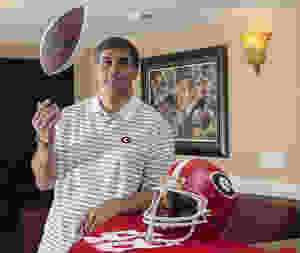
The 1980 University of Georgia football season will never be forgotten. Legendary players such as Herschel Walker, Lindsay Scott, Buck Belue & Scott Woerner starred on the field while coaches Vince Dooley and Erk Russell paced the sidelines. But die-hard Georgia fans know that Frank Ros played as important a role on that team as any other Bulldog.
Ros was a senior linebacker and captain during the 1980 season. And while he excelled on the field, his leadership that season was probably his most important contribution.
Ros did not fit the typical profile of a collegiate football player. “I immigrated to this country on a ship through New York Harbour when I was six years old and then on to Greenville, South Carolina.” Ros credits the lessons learned from his parents for much of his success. “Obviously, when we came here, we didn’t speak English, you know, my dad spoke a little bit of English because he’d already been here for a year. You work hard in life, do right and good things will happen. My mom and dad worked really hard and created a great life here in America. They set a great example for his children. All five children earned a college degree and or masters”.
Ros didn't gravitate immediately to football. It would take some urging by a friend, Ben Cornett, for Frank to give it a try. As a seventh grader, Ros first played on the line. “In my first year of football, I was kind of a heavyset kid, I had to lose five pounds to make the weight limit, as I was a chubby kid. They had me at center and nose guard. In high school, my freshmen year I made the JV team and played guard and noseguard. My Sophie’s year I made the varsity and I played offensive tackle on offense and cornerback on defense (how is that for a weird combination). Then my junior year they moved me to linebacker and offensive guard and that was where I stayed.”
Ros excelled at the new positions and quickly gained the attention of college coaches. “I was recruited by Clemson, South Carolina, East Carolina, Georgia, and a few others.” So why Georgia? “They [Georgia] recruited me throughout my senior year as did Clemson. South Carolina recruited me but went quiet for three or four weeks.” The Gamecocks may have been overconfident because the friend that introduced Frank to football was now the starting tight end for South Carolina. “I would probably have gone to Carolina blindly due to Ben being their along with my two older brothers. But when Georgia head recruiter, Frank Inman came to my hotel room after the SC-NC All-Star high school game and offered me a scholarship, I said, you know what, they’ve been with me the whole time. Plus, if going to compete, I want to compete against the best.” Little did Ros know that leaving South Carolina for Georgia would be as important to his life as leaving Spain for America.
After landing on campus, Ros would describe his first year as “any freshman going in there with high expectations, I wanted to start as a freshman...that was my goal, make the varsity number one, and then try to start. And obviously, there is a lot you have to learn, and back then, not many freshmen played on the varsity. it was very hard. You had freshman teams for the purpose of developing the young young athletes and adjusting them to college life. Fortunately, I played on special teams and got in some at linebacker my freshmen year”.
Throughout my conversation with Frank Ros, he often stressed the importance of putting team over self. “I took the same attitude I always took, I am going to give it everything I got, even in practice, and I didn’t care what the other players thought of me going out their going full speed every play. I am trying to make this team better, and if the players don’t like that, that’s their problem, not mine.” Giving it 100% in practice not only improved Ros, but it also set an example for his teammates.
Balancing personal and team goals was important to Frank’s leadership. “While I had personal goals, team goals were always first on my list. But I think everyone needs to have personal goals because everybody needs to get better every single day. If you don’t have personal goals you won’t get better. I had personal goals. I had been captain on the teams I’d been on before. I was vocal when I needed to be. But I tried to lead by example. I was not going to let anybody outwork me...I was very disciplined. I tried to set a good example not just an athlete but as a student. I took my studies seriously, especially as I matured in high school. You learn if you want to be good at this, you have to work. So to me, it’s just a process. Some people think that leaders are born, I think it’s a combination of being born with that big potential. But also it’s developed through life experiences. My goal was always to be the best I could be and lead in that way.”
Frank was determined that the team and himself excel during his final season. The season began on a high note when Ros and Hugh Nall were selected as captains for the opening game against Tennessee. Before the Notre Dame game, the players voted on an offensive, defensive and permanent team captain. They voted Frank Ros team captain. It is “one of the greatest honors you could get because the players select it. . . we had a lot of players on that team that I thought were excellent leaders,” so being picked as a captain was “just hard for me to believe because that’s not something I expected.”
As a starting linebacker and the captain of the defensive unit, the legendary Coach Erk Russell trusted Ros with relaying the defensive signals. Russell played a major role in Ros’ growth as a player and a man. “One of the greatest privileges I’d ever had was playing for Coach Russell. It’s a shame that not every football player had the opportunity to play for Coach. He is one of those unique individuals who had an ability to get everything out of you without bringing you down. A lot of coaches try to motivate you by criticizing you versus your action. He had an uncanny ability, just by the way he was, of making you the best you could be as an individual by lifting you up. He would treat the fourth teamer the same as he would a first-teamer. You would literally run through a wall for him”.
Before Ros’ senior year, Georgia had been inconsistent. Coach Dooley experienced his worst season ever (5-6) during Frank’s freshman year. A 9-2-1 season in 1978 would follow. People expected another strong season in 1979, but were left frustrated as the Dawgs dropped 5 games. Ros knew what was missing. “We were lacking a breakaway threat at running back, a consistent breakaway threat.” That threat arrived during before the 1980 season in the person of Wrightsville, Georgia sensation Herschel Walker. Frank recalled what Walker meant to that team, “Our senior year we just had a group of guys who had gone through a lot. We'd really been tested and we were committed to winning. We were really close, and when Herschel came in things really started to fall into place. Everybody committed to the goals of the team. Which is really unusual as people tend to focus on themselves.”
A bond would form between the small town freshman tailback and the senior team captain from Spain. Frank recalls how the friendship started, “When they [freshman] come in we have an initiation where you get to pick a little brother. I got the first opportunity so I picked Herschel. It just developed into a little brother-big brother relationship and it’s just grown ever since then.” That relationship remains today because of the “mutual respect (we have) for each other. We are friends, we trust each other. He'll call me for advice on a lot of things and I make sure I’m there when he needs me for something, and he’s there if I need him. It’s just a really true friendship.”
It was evident to Ros that with Walker in the backfield, Georgia was primed for big things. “You can have the pieces in place, however, it doesn’t mean you are going to win. It means you have a chance because you have the major pieces in place.” Georgia now had the pieces to win the National Championship. “We had the unique combination you need to have a chance to win.”
Winning the 1980 National Championship is Frank’s “greatest achievement” on the football field “because the hardest thing as a leader is to get everybody on the same page to focus on the team goal, not your personal goals. And if you do that and put the team first and yourself second, everybody will come in first, and that’s what happened that year. Everybody put themselves second, and at the end of the year, we were number one in the country. You were a part of the number one team in the country, so you were really number one. How many people can say they were the best in the world for one moment in time. That was a big accomplishment.” Focusing on the team’s goals was an important accomplishment for Ros during his captaincy because “that team could have easily been 6-5 if you look at how close some of the games were.”
After his senior season, Frank Ros joined the coaching staff as a graduate assistant while he pursued his Master's degree. As always, Ros was driven to do the best he can. Looking back, “doing well academically and earning my Masters [degree] while achieving a 4.0 was probably my greatest achievement outside of football while in college.”
Success followed Ros into business as he went on to become an executive vice president for Coca-Cola. Retired now, Frank still serves as the de facto captain of the national championship team as he is instrumental in organizing reunions and keeping all his teammates in touch.
Ros feels a “real kinship and brotherhood” with his teammates that he will never forget. Georgia fans will never forget that 1980 season either. Herschel running over Bates and Belue to Scott will always be top of mind. However, let’s not forget players like Frank Ros whose brotherhood and commitment was as important to that wonderful season as anything that occurred on the field.